The Future of Escalator Design
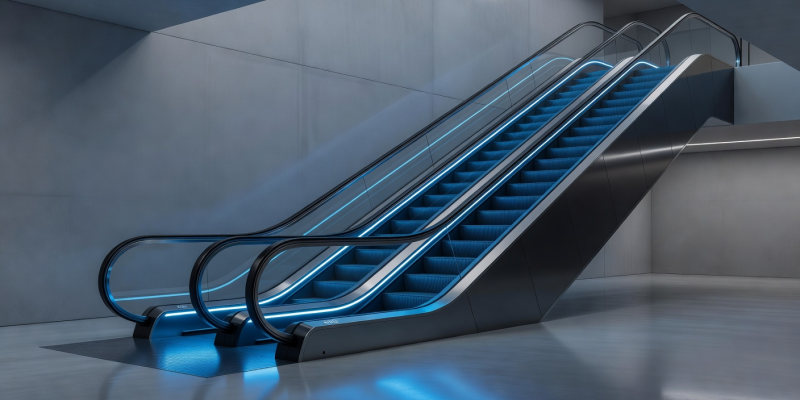
For over a century, the escalator has relied on the same fundamental principle: a chain loop dragging metal steps up an incline via a heavy mechanical gearbox. However, the demands of modern urban infrastructure are shifting. The focus is no longer solely on moving people from point A to point B, but doing so with unparalleled energy efficiency, digital integration, and advanced structural concepts.
The next generation of vertical transportation engineering is poised to introduce radical departures from traditional mechanical designs, transforming how these machines are powered, monitored, and utilized in smart cities.
Energy Efficiency and V3F Drives
Historically, escalators ran at a constant speed, drawing maximum power regardless of whether they were transporting a hundred passengers or running entirely empty. This continuous power draw represents a massive energy sink for transit authorities and commercial buildings.
The industry is rapidly shifting toward Variable Voltage Variable Frequency (V3F) drives coupled with smart passenger detection sensors. These systems allow the escalator to slow to a highly efficient "crawl" speed—or stop entirely—when no passengers are present. As an approaching individual breaks a radar or infrared beam, the V3F drive smoothly accelerates the steps to operational speed before the passenger even steps onto the comb plate. This innovation is reducing escalator power consumption by up to 40% in off-peak hours.
IoT Condition Monitoring
Predictive maintenance is replacing scheduled maintenance, driven by the Internet of Things (IoT). Future escalator designs are embedded with micro-sensors measuring acoustics, vibration, temperature, and electrical draw across every critical moving part.
Instead of a technician manually inspecting a gearbox every month, cloud-based AI continuously analyzes the data streams. If the vibration profile of a specific bearing begins to shift subtly, indicating microscopic wear, the system automatically flags the component for replacement well before a physical failure occurs. This dramatically reduces unplanned downtime and streamlines parts procurement.
Multi-Directional and Maglev Concepts
Perhaps the most radical structural shift on the horizon is the move away from the continuous chain loop. Inspired by magnetic levitation (maglev) trains and rope-less elevator concepts, engineering consortiums are experimenting with linear motor propulsion for escalators.
In a linear-driven system, individual steps are powered independently along a magnetic track. This eliminates the heavy chains, massive drive motors, and the associated lubrication requirements entirely. Without a fixed chain loop, future designs could theoretically allow the step path to undulate, shift horizontally, or merge different passenger streams into a single transit artery, opening up entirely new architectural possibilities for public spaces.
Hygienic Innovations
In response to global health concerns, the physical touchpoints of escalators are evolving. The continuous rubber handrail, traditionally difficult to keep sanitized in high-traffic environments, is seeing significant technological upgrades.
Modern and future builds frequently incorporate integrated UV-C sanitization modules hidden within the return loop of the handrail truss. As the handrail cycles beneath the floor, it passes through an intense ultraviolet light chamber that continuously destroys bacterial and viral pathogens at a molecular level without degrading the structural integrity of the rubber.
As cities grow denser and sustainability mandates become stricter, the escalator is evolving from a brute-force mechanical lifting device into a highly intelligent, frictionless, and adaptive piece of smart infrastructure.