Understanding the Types of Escalators
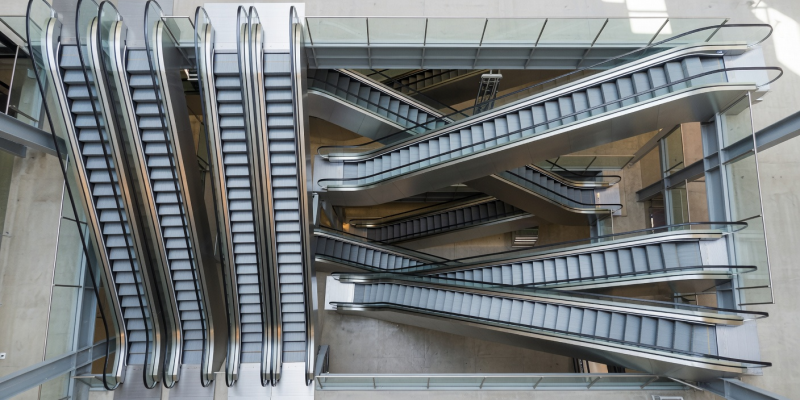
Escalators are widely recognized as one of the most efficient modes of continuous vertical transportation, designed specifically to move high volumes of pedestrians rapidly between floors. However, the generic visual of moving metal stairs belies a range of specific types and architectural configurations engineered for different operational challenges.
When selecting a system for a new construction or retrofitting an existing building, architects and engineers must evaluate physical space constraints, aesthetic goals, and anticipated passenger throughput. Understanding the mechanical variations is the foundational step in this process.
Step-Type Escalators
The step-type escalator is the standard variant implemented worldwide. Recognizable by its solid, articulating metal steps that form a flat landing platform at the top and bottom before staggering into a staircase angle, this system relies on a dual-chain drive mechanism. The inner chain dictates the movement of the steps, while the outer chain manages their leveling geometry as they traverse the truss.
This design is highly resilient and handles continuous heavy loads better than any alternative. Step-type models are almost exclusively chosen for mass transit hubs, airports, and major shopping centers due to their reliability and ease of routine maintenance.
Cleat-Type Escalators
Often considered the direct predecessor to the modern step-type, the cleat-type escalator features treads with deep, unbroken longitudinal grooves. In older systems, these resembled an inclined conveyor belt rather than distinct steps. While full cleat-type tread belts are now largely obsolete due to safety concerns regarding entrapment, the "cleated" concept lives on in the surface design of modern steps and the comb plates that interface with them.
Spiral Escalators
A marvel of spatial engineering, the spiral (or curved) escalator turns on an arc while ascending or descending. The primary advantage of a spiral escalator is aesthetic; it provides a striking architectural focal point and a panoramic view for riders. From a practical standpoint, it can also save floor space by nesting tightly against curved walls or wrapping around central columns.
Mechanically, spiral escalators are significantly more complex than their linear counterparts. The inner and outer radii of the steps must travel at different speeds, necessitating sophisticated chain drives and non-standard step geometries. Consequently, their manufacturing, installation, and maintenance costs are substantially higher, reserving them largely for high-end retail environments and luxury commercial properties.
Wheelchair-Accessible Escalators
A relatively modern innovation, wheelchair-accessible escalators are engineered to temporarily flatten a sequence of steps to create a large platform capable of accommodating a wheelchair or large stroller. This transition is usually triggered manually by an operator or via a specific call button.
When activated, the complex step-chain linkages adjust to keep three or more steps perfectly level with one another as they move up or down the incline, before returning to normal stair configuration for subsequent passengers. While highly beneficial for inclusive accessibility where elevators are impractical, the slow deployment time and increased mechanical complexity mean they are utilized only in specialized scenarios.
Architectural Layout Configurations
Beyond the mechanical type of the escalator itself, the way multiple units are arranged within a building drastically impacts traffic flow.
- Parallel Layout: Escalators traveling in opposite directions are placed side-by-side. This layout is space-efficient and provides clear, immediate access for round-trip travel, heavily favored in subway stations.
- Crisscross Layout: Escalators stack above one another in an 'X' pattern when viewed from the side. This is the most popular layout for multi-story retail stores, as it forces passengers to walk across a floor to continue ascending, increasing their exposure to retail displays.
- Multiple Parallel: Three or more escalators placed side-by-side, allowing operators to change the directional flow based on peak traffic times (e.g., two going up and one going down during morning rush hour).
Choosing the correct escalator type and layout is a critical decision in traffic management engineering. It dictates not just the capital expenditure of the installation, but the long-term flow of human capital through the structure.