The Historical Evolution of the Escalator
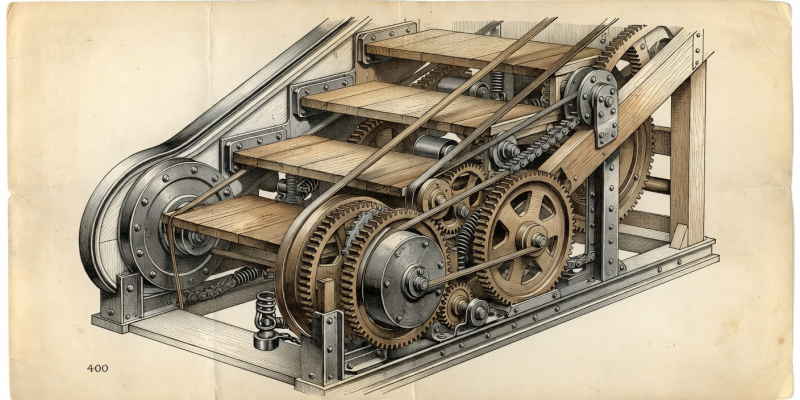
The modern city, defined by its subterranean transit networks and multi-level commercial hubs, owes a great deal of its functional reality to the invention of the continuous moving staircase. The history of the escalator is a narrative of rapid industrial innovation during the late 19th and early 20th centuries, as engineers raced to solve the pressing issue of mass vertical transit.
Early Conceptualization: Nathan Ames
The genesis of the escalator concept dates back to 1859, when patent attorney and writer Nathan Ames secured a patent for what he called "Revolving Stairs". His design featured an equilateral triangle arrangement of steps mounted on a continuous belt, ostensibly to be powered by steam or water. However, Ames never produced a working model. His design remained purely theoretical, lacking the necessary engineering precision in chain drives and handrails required to make it safe or practical.
Jesse Reno and the Inclined Elevator
The first working manifestation of a moving stairway was realized by Jesse Reno, an engineering graduate of Lehigh University. In 1892, Reno patented the "Inclined Elevator." Unlike the modern stepped design, Reno's invention featured a continuous conveyor belt of cast-iron cleats set at an incline of 25 degrees. Passengers rode standing on the grooved incline, holding onto a stationary handrail.
In 1896, Reno installed his machine at the Old Iron Pier at Coney Island in New York City. Operating as an amusement ride, it ferried tens of thousands of passengers in just a few weeks, proving the mechanical viability and public acceptance of continuous vertical transport. It was a massive success, leading to further installations in department stores and transit stations.
Charles Seeberger and the Name "Escalator"
Concurrently, Charles Seeberger acquired patents related to stepped moving stairs (originally drafted by George H. Wheeler) and set about improving the design. Seeberger's vision was closer to what we use today: a mechanism utilizing distinct, flat steps.
In 1899, Seeberger partnered with the Otis Elevator Company to produce the first commercial step-type moving staircase. Seeberger also coined the term "escalator", a portmanteau of the Latin word "scala" (steps) and the word "elevator". In 1900, the Seeberger-Otis escalator was showcased at the Exposition Universelle in Paris, where it won first prize and captured global attention.
Convergence under Otis
For a brief period, Reno's inclined elevators and Seeberger's step escalators competed directly. In 1910, the Otis Elevator Company bought Seeberger's patent rights, and in 1911, they acquired Reno's company as well. By the 1920s, Otis engineers merged the best features of both systems: the flat, comfortable steps of Seeberger's design combined with the safer, grooved cleat surfaces of Reno's design.
This hybrid design allowed for the invention of the comb plate at the landings, revolutionizing safety by allowing the stepped cleats to slip beneath a meshing plate, cleanly scooping off passengers' feet and dramatically reducing entrapment accidents.
The London Underground and Wooden Treads
As deep-level subway systems expanded in the early 20th century, particularly the London Underground, elevators proved too slow for mass transit. Escalators became the standard solution. For decades, these machines were constructed with dense wooden treads (often made of durable woods like hard maple or oak) attached to the metal chains.
However, wood presented a severe fire hazard in subterranean environments. Following the devastating King's Cross fire in 1987, which was initiated beneath a wooden escalator, transit authorities worldwide mandated the complete replacement of wooden systems with the all-metal constructions ubiquitous today.
Modern Evolution
Today, the fundamental mechanical principles established by Reno, Seeberger, and early Otis engineers remain largely unchanged. However, material sciences and digital control systems have transformed their reliability and safety. Variable frequency drives, automated condition monitoring, and advanced metallurgy mean today's machines can run continuously for decades under loads that would have crushed their 19th-century predecessors.